Matthieu Blazy didn't need to say what he wanted to do with Chanel.
He built the space. And the space said everything.
The Grand Palais as language
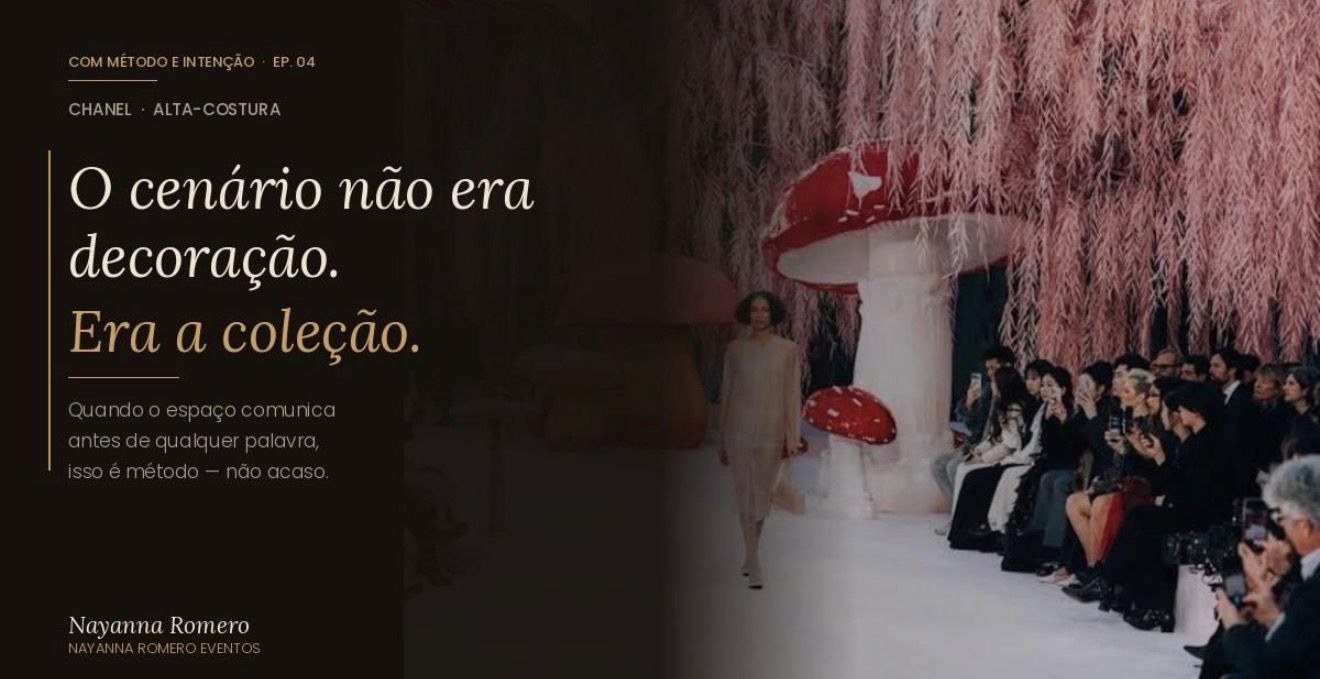
At the Grand Palais, in January 2026, the set for his Haute Couture debut was a garden of giant mushrooms, willow trees in dusty pink, a chalk-white floor like mist, and a circular runway that transformed each model into a bird landing and taking off. The whole composition translated an anonymous haiku Blazy himself cited — a bird landing on a mushroom and immediately vanishing — into spatial language: a circle of meeting, softness in place of grandeur, haute couture as a fleeting instant.
Before the first look, the set had already communicated the collection.
Architecture as narrative
The sculptural mushroom structures functioned as spatial markers, guiding movement and perception. Their tactile forms contrasted with the monumental volume of iron and glass at the Grand Palais, scaling the space down to human dimension and creating moments of intimacy within the hall's immensity.
This isn't décor. It's experience architecture with narrative intent.
The first layer of the message
In the corporate market, it's still common to see scenography used as an aesthetic resource — something that impresses at arrival and is forgotten afterwards. What Chanel demonstrated, under Blazy's direction, is that environment is the first layer of the message. Before the product. Before the word. Before the speech.
Blazy's debut asked for attention, instead of demanding it. And in that gesture, perhaps lies the most luxurious proposition of all.
When I design an event with this awareness, the set is never the last element to be decided. It's the first. Because it's what defines what the guest will feel before any presentation begins.
Method and Intent. Each week, one real brand and one lesson for those who use events as a positioning tool.